Modernizing Legacy
From a Single, Fragmented Website to a Structured, Multi-Platform Ecosystem Supporting Distinct Audiences and Institutional Goals
Virginia Military Institute’s digital presence had not kept pace with its institutional goals.
A single website attempted to serve prospective students, current cadets, faculty, staff, and alumni
Content was fragmented, outdated, and difficult to navigate
Architecture reflected internal structures rather than user needs
Platform limitations restricted flexibility, scalability, and performance
At the same time, the institution was working to:
Increase enrollment and improve yield
Modernize its public narrative
Support a more diverse and evolving Corps of Cadets
The challenge wasn’t a redesign. It was a full ecosystem realignment.
VMI’s existing website was more artifact than asset—outdated tech, fragmented content, and a structure that left users guessing.
My Role
As Director of Online Communications and Branding, I led the transformation of VMI’s digital environment, including:
Defining the platform and ecosystem strategy
Aligning web architecture with audience segmentation and institutional priorities
Establishing governance across admissions, communications, IT, and leadership
Leading cross-functional implementation during a period of organizational change
What I Built
1. A Multi-Platform Ecosystem Strategy
Replaced a single, overloaded website with three purpose-built platforms:
vmi.edu → Public-facing storytelling and institutional narrative
myvmi.edu → Internal portal for cadets, faculty, and staff
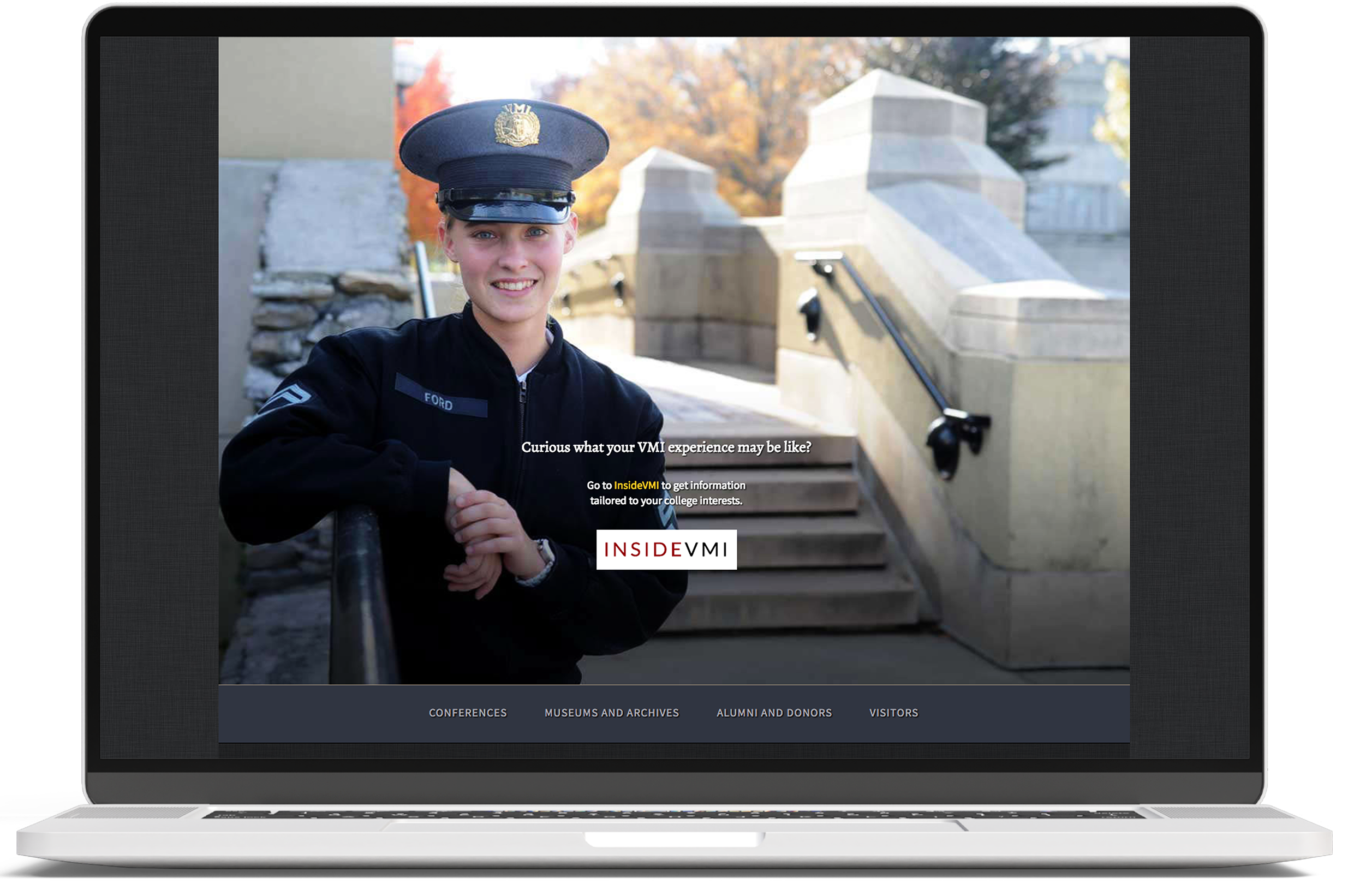
insidevmi.edu → Recruitment-focused experience for prospective cadets and families
Each platform was designed around distinct user needs, behaviors, and goals, rather than institutional structure.
Result: Users could quickly find relevant content without navigating competing priorities.
vmi.edu – Public storytelling and institutional narrative
2. Audience-Centered Information Architecture
Shifted from institution-first to user-centered architecture:
Restructured navigation to align with decision-making pathways
Simplified content hierarchy to reduce cognitive load
Created clearer entry points for key audiences
Result: Improved usability, faster access to information, and stronger engagement across audiences.
myvmi.edu – Internal tools and resources for current students, faculty, and staff
3. Governance and Operational Alignment
Introduced systems to support consistency and scalability:
Established shared content standards and editorial guidelines
Aligned stakeholders across admissions, communications, IT, and leadership
Created workflows that clarified ownership and reduced duplication
Result: A decentralized environment became coordinated and sustainable
4. Platform Modernization and Integration
Led the transition from legacy systems to a more flexible, scalable ecosystem:
Migrated CMS from Ektron to TerminalFour
Introduced WordPress environments for faculty and specialized content needs
Launched an internal portal to centralize tools and resources
Result: Improved performance, flexibility, and long-term scalability across platforms.
5. Integrated Recruitment and Marketing System
Aligned digital platforms with enrollment strategy:
Connected recruitment messaging across web, print, events, and outreach
Supported campaigns such as “Don’t Do Ordinary” and targeted recruitment initiatives
Enabled more consistent storytelling across all prospective cadet touchpoints
Result: Digital infrastructure directly supported measurable enrollment growth and engagement.
insidevmi.edu – Recruitment-focused portal for prospective cadets and families
Outcomes
Created a scalable, multi-platform ecosystem supporting distinct audiences
Improved user experience and reduced friction across digital touchpoints
Increased attendance at 30+ nationwide recruiting events by 26%
Reduced costs by $150,000 annually through operational efficiencies
Contributed to a 19% increase in female applications and improved retention
Supported VMI’s “Uncommon Purpose” capital campaign that exceeded its goal
Why This Matters
Most institutions try to solve digital challenges with redesigns, the real issue is structure.
This work demonstrates that:
A single website cannot effectively serve fundamentally different audiences
Platform strategy is as important as content strategy
Governance is required to sustain improvements over time
Digital ecosystems must align with institutional priorities, not internal silos
I approach digital transformation as an ecosystem challenge—aligning platforms, structure, and governance to support growth, usability, and long-term scalability.