Northrop Grumman | 2022-present
Senior Principal, Web Content Administrator
How a repeatable content framework restructured enterprise capability pages for AI-driven discovery, producing measurable results in a Fortune 100 environment serving 17,000+ global daily users.
17%
Increase in AI summary citations for key pages
Within three months of restructuring content for AI-driven discovery
The context
Most organizations think their AI discoverability problem is a content quality problem. It isn't. The writing is often fine. The expertise is genuine. The issue is architecture, how content is organized, connected, and structured for systems that extract meaning rather than read for it.
The challenge
A structural problem, not a quality problem.
Search behavior has shifted from navigation to answers. For enterprise organizations managing complex technical content at scale, this creates a specific set of risks.
The shift in search
AI systems prioritize context, structure, and extractable meaning not keywords
Zero-click results and AI summaries are replacing traditional search navigation
Users expect answers, not pages, scannability matters as much as depth
Generative engine optimization (GEO) is the new baseline for discoverability
The enterprise risk
Dense, linear content built for page-based reading vs machine extraction
Inconsistent narrative structure across high-value capability pages
Limited visibility in emerging AI-driven search
No repeatable model for content authors to follow
The issue wasn't content quality. It was how content was structured, connected, and surfaced to systems that don't read the way humans do.
My role
From page optimization to system design.
Structuring content for human decision-making and machine interpretation
Embedding AI-aware practices into editorial workflows and governance
Leading internal enablement through training sessions and LLM webinars
Advancing content strategy as part of the corporate AI Search team
Applying frameworks across high-value capability areas
Establishing requirements at the point of content request, not after
The framework
Narrative-to-Navigation.
A repeatable four-stage model that structures complex enterprise content for both human comprehension and machine extractability — applicable across capability areas, sectors, and content types.
01: problem
Define the mission-level challenge first. Establish context before capability. Give both humans and AI systems a clear frame of reference.
02: solution
Present capabilities in modular, scannable sections. Layered for both executive scanning and deep technical exploration.
03: proof
Integrate authority signals within the narrative — not as separate credential sections, but woven into the context where they reinforce meaning.
04: deeper exploration
Connect related topics through structured pathways. Internal linking is more than navigation, it is part of the semantic architecture.
This framework is designed to be content-agnostic and applicable whether the topic is microelectronics, autonomous systems, or mission-critical software. The structure does the heavy lifting so authors focus on expertise, not optimization.
What we built
Five shifts.
Each change addressed a distinct failure in how enterprise content was being structured, surfaced, and adopted.
01: from page to system
Reframed content around intent, not keywords
Introduced layered structures supporting scanning and deep technical exploration
Designed content to connect across related topics through structured internal pathways
Result: Content became easier to navigate, interpret, and reuse — for users finding answers and for AI systems extracting meaning.
The challenge is not just the complexity of the content, but the scale at which any new standard has to be applied consistently.
02: machine-aware content design
Structured heading hierarchies aligned to semantic meaning,
Summary and key takeaway modules designed explicitly for AI extraction
Enhanced internal linking to reinforce topic authority and contextual relationships
Schema and metadata improvements to support structured parsing
Result: 17% increase in AI summary citations for key pages within three months.
03: AI-enabled workflows and adoption
Introduced AI-assisted workflows for metadata, tagging, and summaries using Northrop Grumman's internal branded LLM
Led training sessions and webinars for sector communication strategists
Established structured key takeaway and summary requirements at the point of content request
Result: AI adoption moved from isolated experimentation to embedded, repeatable practice across teams.
04: the model in practice
Before
Dense, linear content requiring front-to-back reading
No clear entry points for scanning or non-linear navigation
Inconsistent narrative flow
No summary or extraction points for AI systems
Internal linking sparse and unstructured
After
Modular structure supporting both scanning and deep exploration
Clear narrative progression: problem → solution → proof → exploration
Integrated summaries and key takeaways for AI extraction
Structured cross-linking reinforcing topic authority
Model adopted across additional capability areas
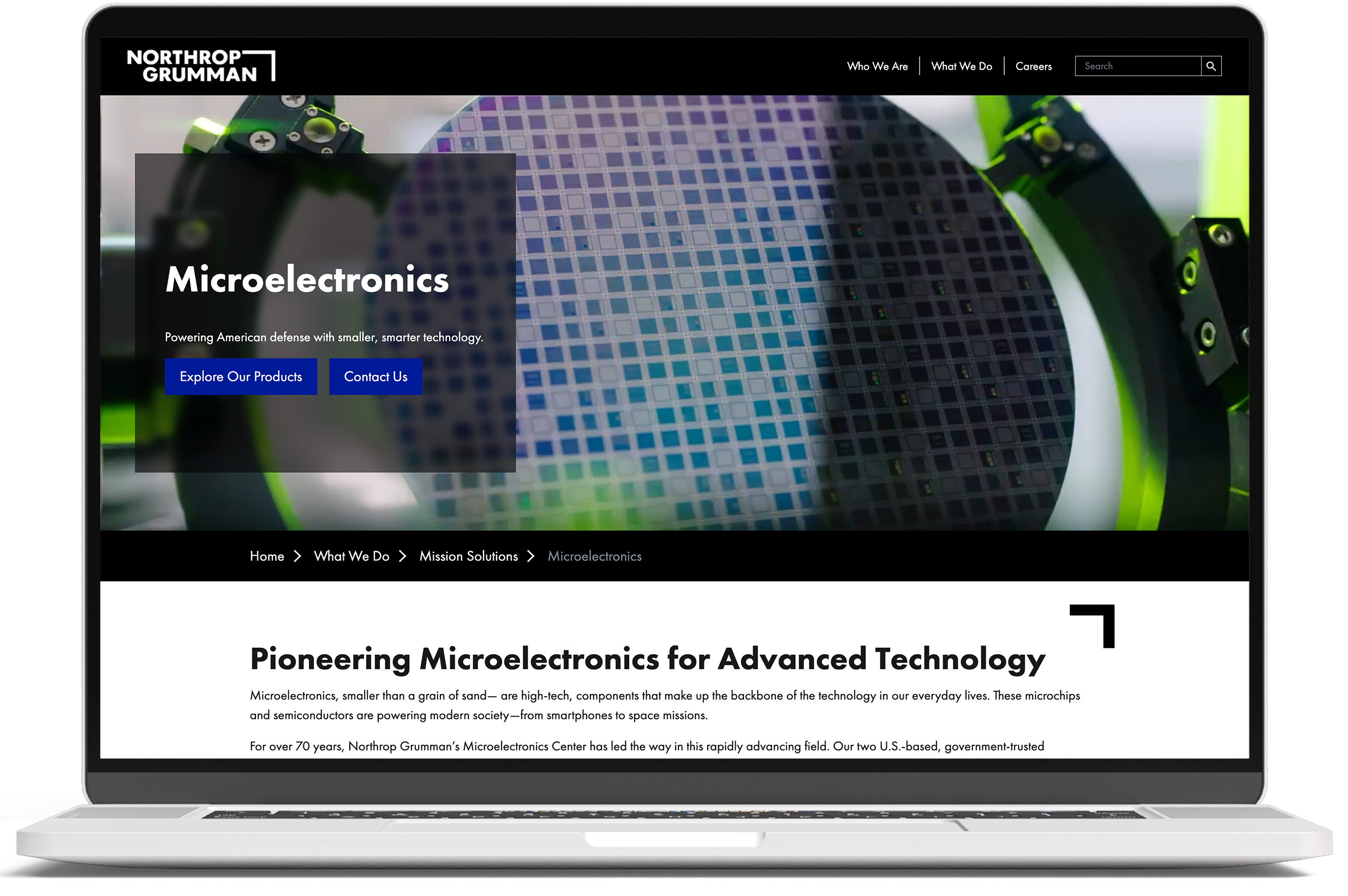
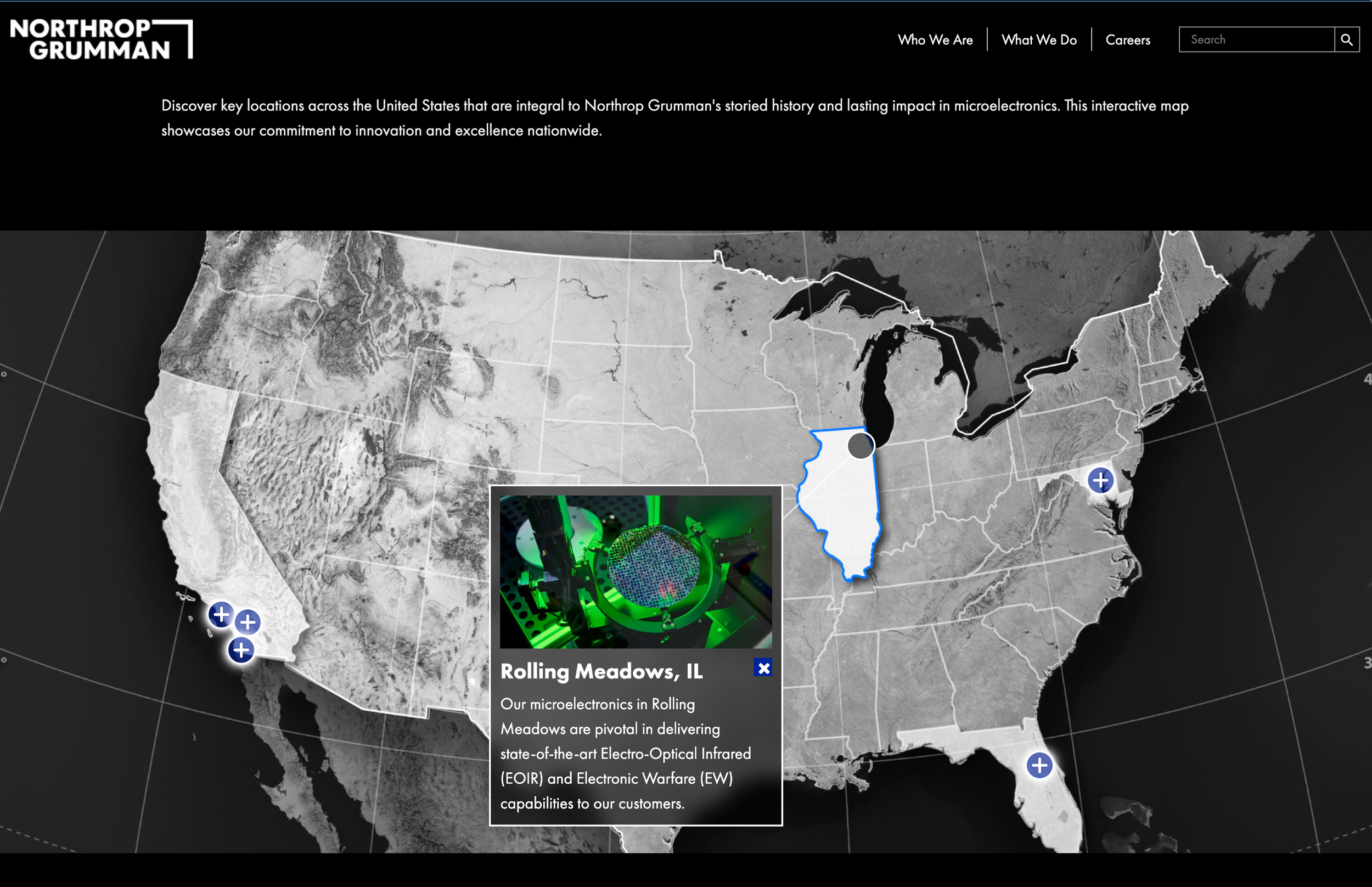
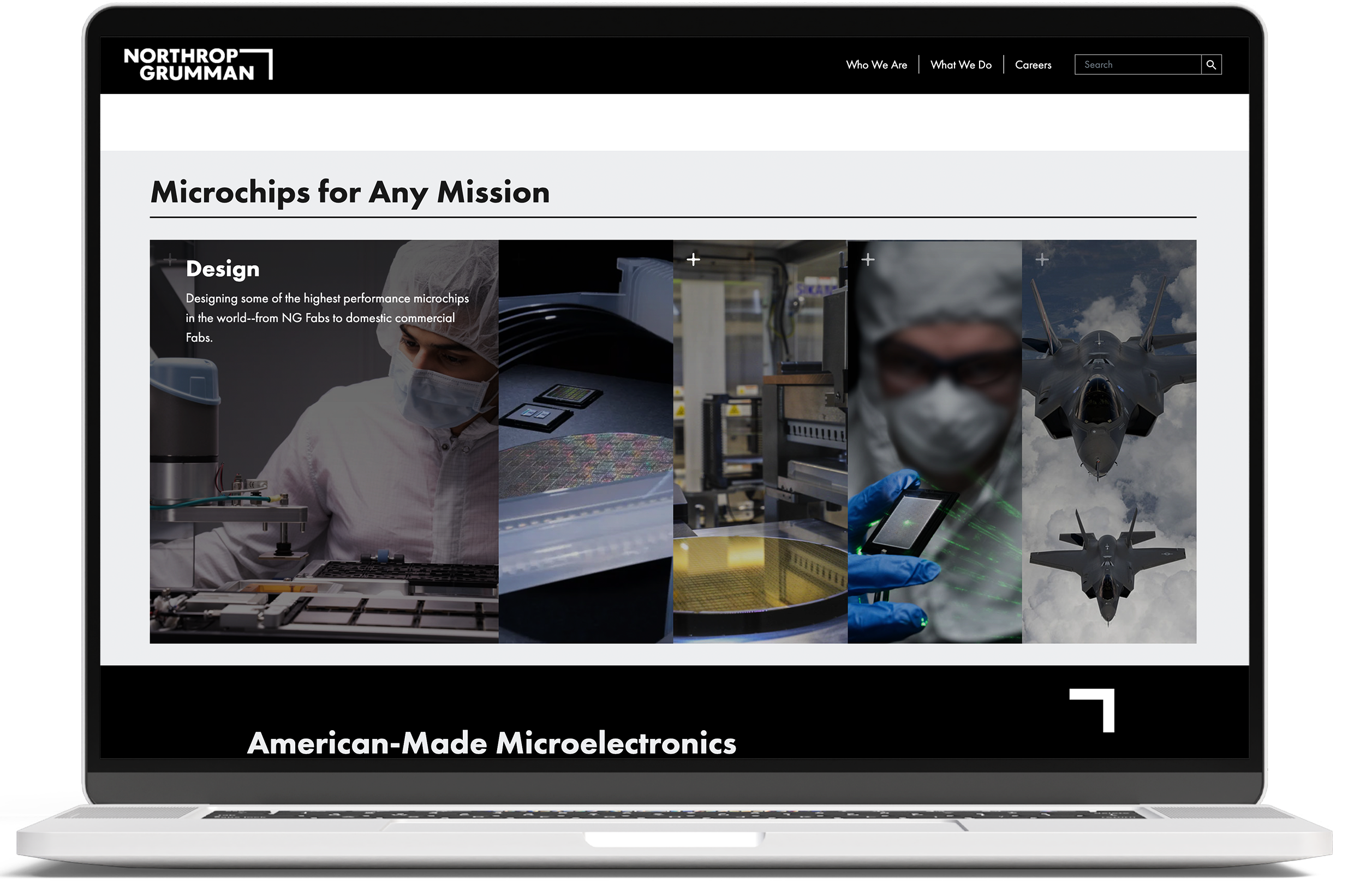
The Microelectronics capability page after applying the Narrative-to-Navigation Framework. This page became the internal model demonstrating how the approach could scale across other high-value capability areas.
Result: The page became the internal reference model for AI-ready content architecture, adopted as the standard for restructuring across other capability areas.
05: a scalable model
Documented the Narrative-to-Navigation Framework as a reusable standard
Established requirements at the intake stage before pages are created
Aligned the model with the broader enterprise AI Search team roadmap
Result: One-off page creation gave way to repeatable, standards-driven production reducing revision cycles and improving consistency across the enterprise content ecosystem.